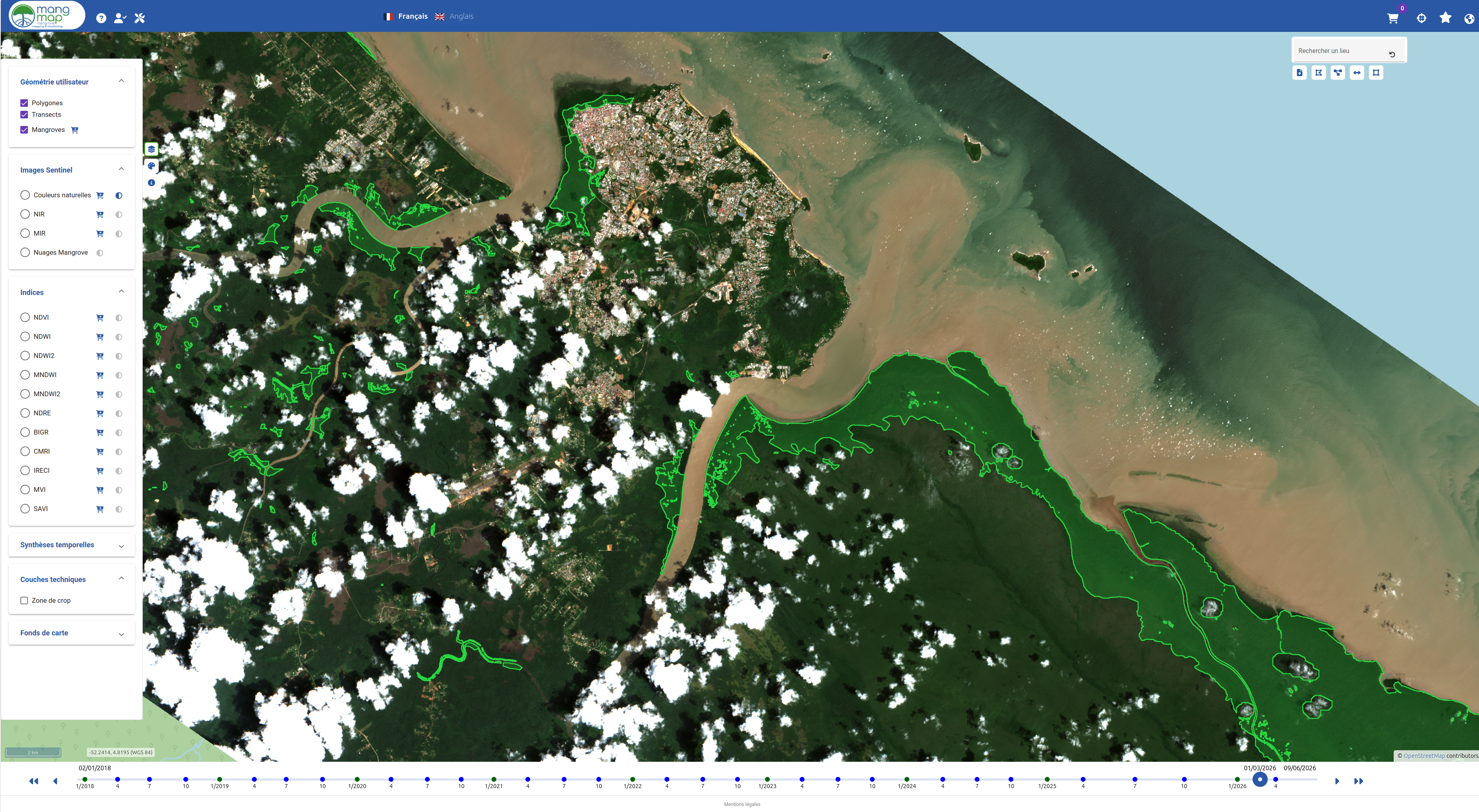
Covering nearly 700 km² and occupying around 80% of its coastline, French Guiana's mangroves account for 68% of all French overseas mangroves. At the national level, French Guiana and New Caledonia together hold the largest areas, with approximately 70,000 ha and 25,000 ha respectively, around 93% of France's total mangrove cover.
What makes French Guiana's mangrove truly unique in the world, however, is its mobile nature. The morphology of the Guianese coastline is directly shaped by the Amazon River, through its inputs of sediments, freshwater, and dissolved matter. Each year, 280 million cubic metres of Amazon sediments are carried to French Guiana by ocean currents, accumulating to form mudbanks several kilometres long and wide. Coastal mangrove forest establishes itself within months once a mudbank arrives and stabilises, then disappears within weeks as the bank moves on, driven by the equatorial current generated by the trade winds.
Several types of mangrove can be identified in French Guiana. The coastal mangrove, whose extent and location shift from year to year, is a mobile forest: pioneer on newly emerged mudflats, it grows, matures, and retreats in step with the migrating mudbanks. White mangrove (Avicennia germinans), the characteristic species of this environment, is equipped with pneumatophores — roots that protrude above the ground — which aid respiration and provide better anchorage. Further inland, along the rivers, estuarine mangrove is found, dominated by red mangrove (Rhizophora racemosa), easily recognised by its long stilt roots. The estuaries are home to the oldest and tallest mangrove stands, reaching heights of over 30 metres.
These forests serve as spawning and nursery grounds for crustacean and fish larvae, forming a major reservoir of biodiversity, with no fewer than 100 fish species and 34 decapod crustacean species (crabs and shrimps) recorded. Paradoxically, this short-lived and unstable ecosystem is characterised by high productivity and substantial standing biomass — up to 350 tonnes per hectare.
The health of French Guiana's mangroves is considered good, partly because their distinctive natural dynamics make them less vulnerable to human pressures than mangroves elsewhere in the world. Their well-preserved condition makes them a highly relevant study site for investigating the natural response of mangrove ecosystems to climate change.
It is in this context that French Guiana has been integrated into the MangMap platform, providing a long-term satellite monitoring tool to better understand and protect these exceptional coastal forests.
Sources:
- DGTM Guyane – Les mangroves
- Comité Eau et Biodiversité de Guyane – Les mangroves
- Géoconfluences (ENS Lyon) – Bancs de vase, mangroves et plages en mouvement le long du littoral de Guyane
- LEMAR / IUEM – Chantier Guyane
- Thèse : https://theses.hal.science/tel-05604552v1
- Thèse : https://hal.science/tel-04871299